Why sound matters when you’re chasing speed
If you’ve ever watched your words-per-minute nosedive the moment a nearby conversation starts, you’ve felt the psychoacoustics of distraction. In open-plan and home offices alike, intelligible speech grabs attention and taxes working memory, which undermines task performance—even when you’re not trying to listen. Field research in real offices shows that speech is a major distractor and that adding controlled, broadband sound can reduce how often people feel compelled to “cope” (e.g., wear headphones) and can improve short‑term mental health ratings. Crucially, masking systems aim for a steady spectrum and modest level so the background stays consistent rather than spiky. One large field study recommends keeping background levels below about 45 dB(A) to avoid annoyance, and notes that low‑to‑mid‑frequency–weighted spectra (roughly −7 to −9 dB per octave) are generally best accepted. (pure.tue.nl)
Pink, brown, babble: which background helps typing?
- Pink noise rolls off energy as frequency rises (−3 dB/octave), while brown (aka red) noise rolls off faster (−6 dB/octave). A controlled study of noise “color” found that red/brown, pink, and white noise each improved several cognitive test scores versus silence—evidence that stable, broadband noise can support performance for some tasks and listeners. (pmc.ncbi.nlm.nih.gov)
- In an office‑style lab with a typing task, conversation noise cut performance; adding pink noise or a sound‑masking signal offset that drop and improved comfort—exactly the effect typists want. (jstage.jst.go.jp)
- Multiple studies link the intelligibility of background speech—not merely its loudness—to performance decrements. The classic Hongisto model quantifies how rising Speech Transmission Index (STI) predicts larger performance drops, and subsequent work refines that relationship. In short: the more understandable the chatter, the more it derails you. (onlinelibrary.wiley.com)
Put together, the latest evidence suggests that steady, low‑fluctuation masking (pink or brown) at a comfortable, sub‑45 dB(A) background can blunt the impact of speech—especially the modulations in speech that hook your attention. (pure.tue.nl)
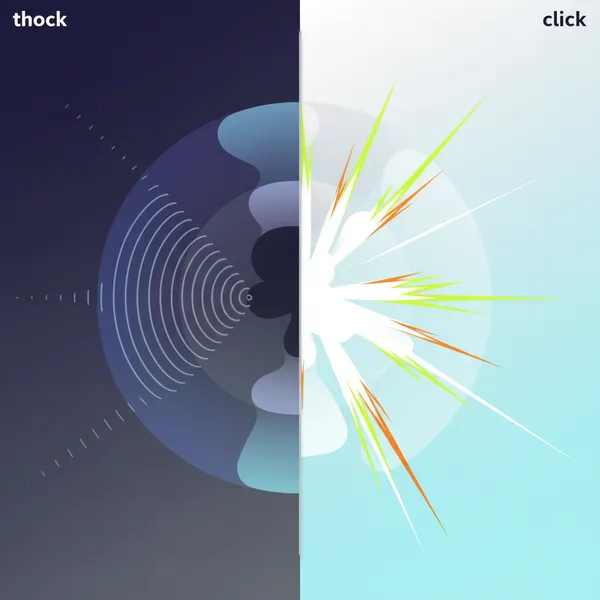
Where keyboards enter: the psychoacoustics of “thock” vs. “click”
Keystrokes are short transients with energy spread broadly across the spectrum. Security/forensics papers that analyze keystroke acoustics (for side‑channel attacks) consistently find most of the discriminative energy between roughly 400 Hz and 12 kHz—precisely the band where “bright,” clicky tones live. (cse.msu.edu)
Recent engineering studies also show that different keys and boards tilt energy toward different frequency regions (e.g., some keys concentrate more energy in the 1–5 kHz range), and that simple spectral descriptors like spectral centroid and roll‑off capture these differences. That means sound profile isn’t just a vibe; it’s measurable. (mdpi.com)
Inference: a darker, “thockier” board (lower spectral centroid, faster decay damping high‑frequency resonances) should be easier to mask with gentle pink/brown noise than a sharp, high‑centroid “click” that competes in the same band as consonants and other attention‑grabbing transients. We can test that directly. (Inference based on the cited spectral analyses.) (cse.msu.edu)
Run in‑test A/B trials on our typing test
Here’s a practical, repeatable protocol you can run right in the typing test:
1) Calibrate your baseline
- Use a phone sound‑level app and over‑ear headphones. Set pink or brown noise to a steady 42–45 dB(A) at the ear—quiet enough to be comfortable for long sessions, aligned with office masking guidance to minimize annoyance. (pure.tue.nl)
2) Randomize sound conditions
- Do 5–8 one‑minute trials per condition (shuffle the order):
- Silence (control)
- Speech babble (multi‑talker café chatter)
- Calibrated pink noise
- Calibrated brown noise
- Keep the same overall level across conditions so you’re testing spectrum/type, not volume. (onlinelibrary.wiley.com)
3) Log performance
- WPM (speed)
- Error rate (backspaces or uncorrected errors per 100 words)
- Consistency: compute the coefficient of variation (CV) of WPM across 5‑second windows per trial—lower CV = steadier flow.
4) Relate results to your keyboard’s sound profile
- Record one minute of your typing in a quiet room. Compute:
- Spectral centroid (higher = brighter/clickier)
- Dominant frequency band (e.g., 1–5 kHz spike vs. sub‑1 kHz “thock” body)
- Decay time to −20 dB (long ring vs. damped)
- These are standard descriptors used in keystroke‑acoustic research; you can approximate them with free audio tools or simple scripts. Then, check whether a lower centroid or shorter decay correlates with smaller performance gaps between silence and speech, or with stronger gains from pink/brown noise. (mdpi.com)
5) Analyze and decide
- If speech babble reliably dents your WPM/consistency more than pink/brown noise does, you’ve quantified your personal irrelevant‑speech effect—and your masking solution. If pink or brown reliably improves both speed and error rate over silence, you’ve found a productive background. If the gains are small, try slightly different levels (±2–3 dB) or switch colors; individual factors like noise sensitivity matter. (sciencedirect.com)
Practical tips you can use today
- For open‑plan offices: if you can’t add an installed masking system, use comfortable‑level pink/brown noise via sealed headphones to smooth out speech fluctuations. Avoid cranking volume; the goal is gentle masking, not blasting. (pure.tue.nl)
- For home offices: pink noise around 42 dB(A) often feels less “hissy” than white noise and may be easier to forget is there. If your space is already quiet, try brown noise for a softer low‑end tilt. (pmc.ncbi.nlm.nih.gov)
- Tune your keyboard for focus: add case/plate damping and desk mats to shorten decay and tame high‑frequency “click.” If you prefer clicky switches, you may need a touch more high‑frequency masking (or a lower‑brightness board) to keep transients from pulling attention. (Inference from spectral findings.) (cse.msu.edu)
- Expect task and person differences: language tasks and memory‑heavy work are especially speech‑sensitive, and some people are more noise‑sensitive than others—exactly why your own A/B is worth running. (sciencedirect.com)
Bottom line
- Speech is uniquely distracting; stable, spectrally shaped masking can help, especially at modest levels and when tuned to listener comfort. (pure.tue.nl)
- Your keyboard’s acoustic “bright vs. dark” profile likely changes how easily masking noise protects your flow. Measure it, test it, and pick the combo that gives you the fastest, steadiest, least error‑prone typing.