Why test keycap profiles with data, not vibes?
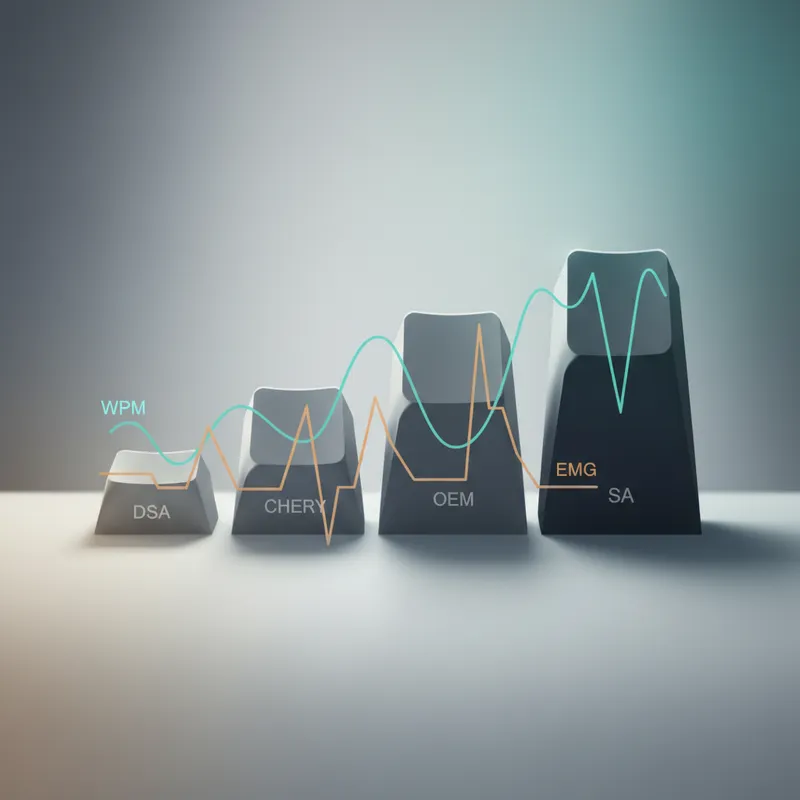
We argue about keycap sound and feel, but the real question is whether profile meaningfully changes typing performance and comfort. Profiles differ in height, sculpt, and top shape: Cherry and OEM are sculpted and mid-height; SA is tall and spherical; DSA is uniform and low-to-mid. Those geometry choices can alter finger travel and wrist angle—two factors tied to muscle load. Let’s move beyond anecdotes with a replicable WPM/accuracy protocol that also lets you capture optional EMG or posture proxies. (keebdepot.com)
Quick profile refresher (and why it might matter)
- Cherry: Sculpted, medium–low height; widely used as a balanced baseline. Many users find transitions between rows smooth. (yuzukeycaps.com)
- OEM: Sculpted, a bit taller than Cherry on most sets; common on prebuilts. (tomshardware.com)
- SA: Tall, heavily sculpted, spherical tops; dramatic look/sound, but greater finger travel. Some vendors list SA around 16.5 mm at its tallest. (keebsforall.com)
- DSA: Uniform rows at equal height and angle; fewer orientation cues, but easy layout swaps. (keebdepot.com)
Those shape and height differences shift how far fingers move and how your wrist settles. Typing research shows device geometry and slope can change forearm muscle activity and wrist posture—so profile‑driven changes in reach and hand posture are plausible levers on comfort and consistency. (pmc.ncbi.nlm.nih.gov)
What the science says about posture and muscle load
- Keyboard slope and height: In a study of 16 typists, lowering keyboard slope reduced wrist extension and slightly decreased wrist extensor (%MVC) activity—especially in the extensor carpi ulnaris. Lower angles can be gentler on extensors. (pubmed.ncbi.nlm.nih.gov)
- Device differences matter: A lab study comparing short- vs longer‑travel devices found significant changes in forearm extensor activity across devices; higher-speed test blocks also elevated EMG across muscles. Translation: small geometry changes can measurably affect load. (pmc.ncbi.nlm.nih.gov)
- Relevant muscles to watch: During typing and keyboard tasks, forearm flexors (FDS/FCR) and extensors (ED/ECR/ECU) are commonly monitored with sEMG. (pmc.ncbi.nlm.nih.gov)
While there’s no peer‑reviewed head‑to‑head of Cherry vs OEM vs SA vs DSA yet, the mechanism links are clear: geometry nudges wrist angle and reach, which can alter muscular demand and perceived fatigue. (pmc.ncbi.nlm.nih.gov)
The one‑week EMG+WPM protocol (replicable and cheap)
Use the same keyboard, switches, desk, chair, and typing test across the week. Only the keycaps change.
1) Baseline setup (Day 0)
- Fix keyboard angle and height; if you use a wrist rest, keep it for all tests.
- Choose a typing test and keep it constant (e.g., TypeTest’s timed texts). Track median WPM and accuracy rather than single peaks. (typetest.io)
- Optional wrist‑angle proxy: Use a smartphone goniometer app or simple photogoniometry to capture wrist extension (degrees) at rest on home row. Studies show phone‑based measures can be valid and reliable for wrist ROM, though wrist extension can be a bit less accurate—so be consistent with your method. (pmc.ncbi.nlm.nih.gov)
2) Test schedule (Days 1–7)
- Pick two profiles to compare first (e.g., Cherry vs OEM); run three days each, then a final endurance day.
- Each day: 5 runs of 60–90 seconds, same time of day. Log WPM, accuracy, error count, and a 0–10 fatigue rating. Prioritize medians over bests. (typetest.io)
- Endurance (Day 7): 20 minutes of normal writing, then a test block. Note finger/forearm fatigue and error recovery.
3) Optional EMG add‑on (low cost)
- Hardware: A MyoWare 2.0 Muscle Sensor or an OpenBCI board with EMG electrodes is sufficient for basic amplitude trends. These hobbyist systems are widely used for introductory EMG. (mm.digikey.com)
- Electrode placement: Place bipolar electrodes over the extensor digitorum communis (EDC) on the dorsal forearm and flexor carpi radialis (FCR) on the volar side; orient along the muscle fibers with ~20 mm inter‑electrode distance when possible. Reference on a neutral bony prominence. Follow SENIAM recommendations for placement and reporting. (seniam.org)
- Normalization: Record a brief maximal voluntary contraction (MVC) for each muscle (e.g., resisted wrist extension/flexion) to express task EMG as %MVC—standard practice for comparability. (researchgate.net)
- Sampling and filtering: Sample ≥500 Hz; rectify and low‑pass for an envelope (e.g., 3–6 Hz) to compute median EMG amplitude over each typing run. Many OpenBCI guides show this workflow. (docs.openbci.com)
- Safety note: sEMG is non‑invasive, but if you have skin irritation or any neuromuscular condition, skip EMG and use posture proxies instead.
What to compare (and how to decide)
- Speed and control: Median WPM and accuracy per day. Keep accuracy at or above your baseline floor—speed with sloppy accuracy is a false win. (typetest.io)
- Muscle load or proxies: Median %MVC for EDC/FCR, or median wrist extension angle if using a phone proxy (less extension is generally favorable). (pubmed.ncbi.nlm.nih.gov)
- Fatigue: End-of-day 0–10 rating; note any row‑to‑row overshoots.
Choose the profile with the better median performance under control (accuracy protected) and equal or lower load/fatigue. Expect patterns like: Cherry ≈ OEM for many users, SA trending slower with higher effort unless you adapt, and DSA needing a longer acclimation but rewarding consistent touch typists. Your data is the tie‑breaker. (keebdepot.com)
Copy‑paste datasheet (CSV)
Paste into a spreadsheet and duplicate one tab per comparison.
```
participant_id,keyboard,switch,profile,day,run,wpm,accuracy_pct,errors,edc_pct_mvc,fcr_pct_mvc,wrist_ext_deg,fatigue_0_10,notes
P001,QK65,MX Brown,Cherry,1,1,---,---,---,---,---,---,---,""
P001,QK65,MX Brown,Cherry,1,2,---,---,---,---,---,---,---,""
P001,QK65,MX Brown,OEM,4,1,---,---,---,---,---,---,---,""
```
Analysis tips:
- Use medians per day and per profile; graph median WPM vs median %MVC or wrist angle.
- Compute deltas vs baseline: ΔWPM, Δ%MVC, Δwrist angle. Lower %MVC/angle with stable accuracy is a win.
Practical setup tips
- Keep one keyboard and switch set; only swap caps. Even plate/case changes can shift EMG. (pmc.ncbi.nlm.nih.gov)
- Re‑check keyboard tilt after each cap swap—taller sets can increase effective height and wrist extension. (pubmed.ncbi.nlm.nih.gov)
- If you already type on OEM, Cherry is a low‑risk first test. If you love spherical tops, compare DSA against your current sculpted set, but give it extra acclimation days. (tomshardware.com)
The bottom line
Keycap profile can shift speed, accuracy stability, and fatigue by nudging posture and movement. With a week of controlled testing—and optional EMG or validated phone‑based angle tracking—you can pick the profile that stays fast when you’re tired, not just when you’re fresh. For a friendly walkthrough of median‑based testing (and more profile context), see TypeTest’s guide. (typetest.io)