The quick take
If you type a lot, lighter isn’t just “nice”—it’s often kinder to your muscles. Lab studies consistently show that higher actuation forces and ultra‑short key travel increase forearm muscle activity (EMG), applied finger force, and reported discomfort. Longer travel and/or crisp feedback can help, but very stiff keys and very short travel are the risky combo. (pubmed.ncbi.nlm.nih.gov)
What the evidence says (in plain English)
- Key stiffness drives EMG and force: In repeated‑measures experiments with experienced typists, raising make (actuation) force from roughly 0.47 N to ~1.02 N increased fingertip force by ~40% and flexor EMG by ~20%. In a separate two‑hour typing trial, the stiffer 0.83 N keyboard produced 54% more peak force and 34% higher flexor EMG than a 0.28 N keyboard. Discomfort also rose on the stiff keyboard. Translation: heavier springs make your forearm work harder. (pubmed.ncbi.nlm.nih.gov)
- People press harder than the switch “needs”: During normal typing, peak finger forces often exceed the switch’s make force five‑fold (overall average ~2.54 N peak vs. 0.47 N make force ≈ 5.4×). This overtravel/overshoot helps explain why reducing make force can meaningfully cut load even if you don’t type “lighter.” (pubmed.ncbi.nlm.nih.gov)
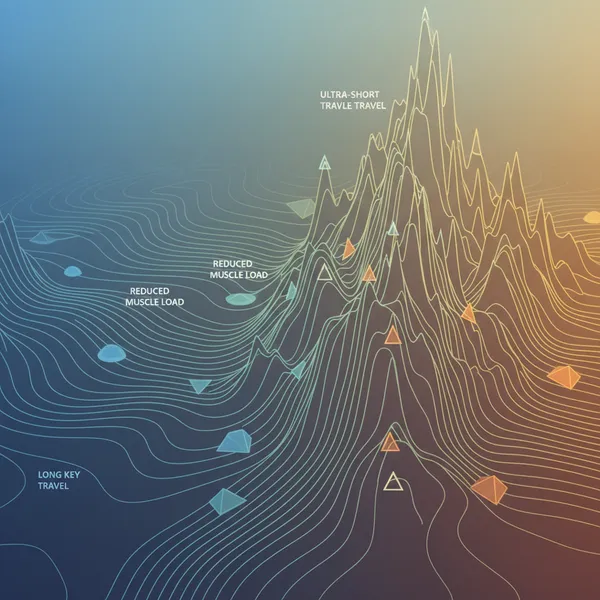
- Ultra‑short travel increases load and slows you down: In a study of four micro‑travel laptop keyboards (0.55–1.6 mm), the shortest‑travel dome board (0.55 mm) caused 6–8% higher forearm muscle activity, 12% higher typing force, ~8% slower speed, and about twice the discomfort compared with longer‑travel (1.3–1.6 mm) scissor designs. Takeaway: short travel can raise effort and discomfort without improving performance. (pubmed.ncbi.nlm.nih.gov)
- Feedback matters: An older field/lab study found that a buckling‑spring keyboard with a strong tactile/auditory click (~0.72 N) yielded EMG levels comparable to a much lighter 0.28 N board, whereas a 0.83 N quiet rubber dome produced the highest EMG and discomfort. Clear click/tactility can reduce how hard you press—even at a somewhat higher nominal force. (pubmed.ncbi.nlm.nih.gov)
How that maps to buying mechanical keyboards in 2026
- Target make force in the ~0.35–0.45 N range (≈35–45 g). Studies suggest EMG and fingertip force rise substantially as you push past ~0.47–0.5 N, especially toward ~0.8–1.0 N. For many typists, “35–45 g” provides a sweet spot between low effort and control. (pubmed.ncbi.nlm.nih.gov)
- Prefer moderate‑to‑long travel over ultra‑short: Desktop mechanical switches with ~3.2–4.0 mm total travel and a clear tactile event generally beat ultra‑short travel (<1 mm) for muscle load and comfort at similar speeds. If you must go low‑profile, avoid the very shortest travels around ~0.5 mm. (pubmed.ncbi.nlm.nih.gov)
- Use tactility as a tool, not an excuse for heavy springs: Tactile/clicky feedback can curb overshoot, but that doesn’t mean you should jump to 70–80 g springs. If you like a crisp bump, pair it with lighter springs (e.g., 37–45 g) to keep loads down. (pubmed.ncbi.nlm.nih.gov)
- Standards set a wide “okay” range—but your body may prefer the low end: ISO 9241‑410 allows 1.5–6.0 mm travel (preferred 2–4 mm) and forces from 0.25–1.5 N (preferred 0.5–0.8 N). Those ranges permit many designs, yet the experimental EMG/force data above favor lighter forces and not‑too‑short travel for comfort during high‑volume typing. (iso.org)
A simple “force‑budget” calculator (per 10,000 keystrokes)
Think of two numbers: the switch’s make force and how much you typically overshoot it. Research shows typists often peak at 2–7× the make force per press (lower multiples on stiff keys, higher on light keys). Use this to estimate your cumulative peak‑force exposure. (pubmed.ncbi.nlm.nih.gov)
- Inputs you need:
- Make force in Newtons (N). To convert grams to N: N ≈ grams × 0.00981.
- Overshoot factor (try 3.5× as a realistic default; use 2.5× for a very light touch, 5× if you bottom out aggressively). Based on studies reporting ~2.2–7.0×. (pubmed.ncbi.nlm.nih.gov)
- Formula:
Force budget (N over 10k presses) ≈ Make_Force_N × Overshoot_Factor × 10,000
Minimum budget (no overshoot) ≈ Make_Force_N × 10,000
```
- Examples (using a 3.5× default):
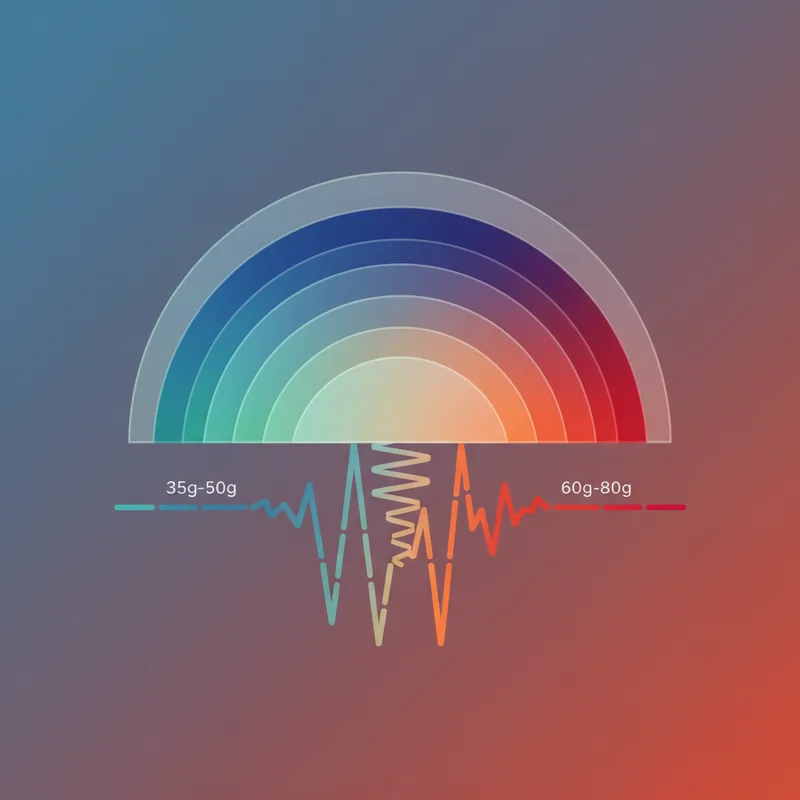
- 35 g (0.343 N): ~12,005 N per 10k presses
- 45 g (0.441 N): ~15,435 N per 10k presses
- 60 g (0.588 N): ~20,580 N per 10k presses
- 80 g (0.784 N): ~27,440 N per 10k presses
Practical setup tips to cut EMG and fatigue without losing accuracy
- Choose lighter springs first, then tune control: Start around 35–45 g. If you feel accidental presses, try a slightly firmer spring (45–50 g) or a sharper tactile bump rather than jumping to 60–70 g. Evidence suggests the heavy end increases muscle load and discomfort. (pubmed.ncbi.nlm.nih.gov)
- Don’t chase ultra‑short travel: If key wobble or low profile appeals to you, stick to ~1.3–1.6 mm rather than ~0.5 mm. On full‑height boards, 3.5–4.0 mm with clear tactility is a safe bet for comfort. (pubmed.ncbi.nlm.nih.gov)
- Reduce bottom‑out shock: Consider desk mats, softer keycaps, or switch dampers; and practice “floating” at the tactile event. A crisp tactile/click signal helps you stop earlier. (pubmed.ncbi.nlm.nih.gov)
- Mind posture and strike force: Independent of switches, many typists push far harder than necessary (often ~5× make force); making a habit of lighter taps pays off. Keep wrists neutral and forearms supported. (pubmed.ncbi.nlm.nih.gov)
What about speed and accuracy?
The micro‑travel study found the shortest‑travel board was about 8% slower and rated as more difficult, while the longer‑travel scissor boards had the least discomfort without hurting performance. In force‑focused studies, lowering make force within a modest range (≈0.34–0.47 N) did not degrade performance measures; loads simply went down. In other words, you can usually pick lighter springs without sacrificing speed or control. (pubmed.ncbi.nlm.nih.gov)
Bottom line
- Lighter springs and not‑too‑short travel reduce muscle activity, applied force, and discomfort for most typists. Aim for 35–45 g and ~3.2–4.0 mm travel (or ~1.3–1.6 mm on low‑profile boards). Use our force‑budget to compare options—and let tactility help you avoid bottoming out. Your hands will notice the difference after 10,000 presses. (pubmed.ncbi.nlm.nih.gov)