Why an EMG typing mode now?
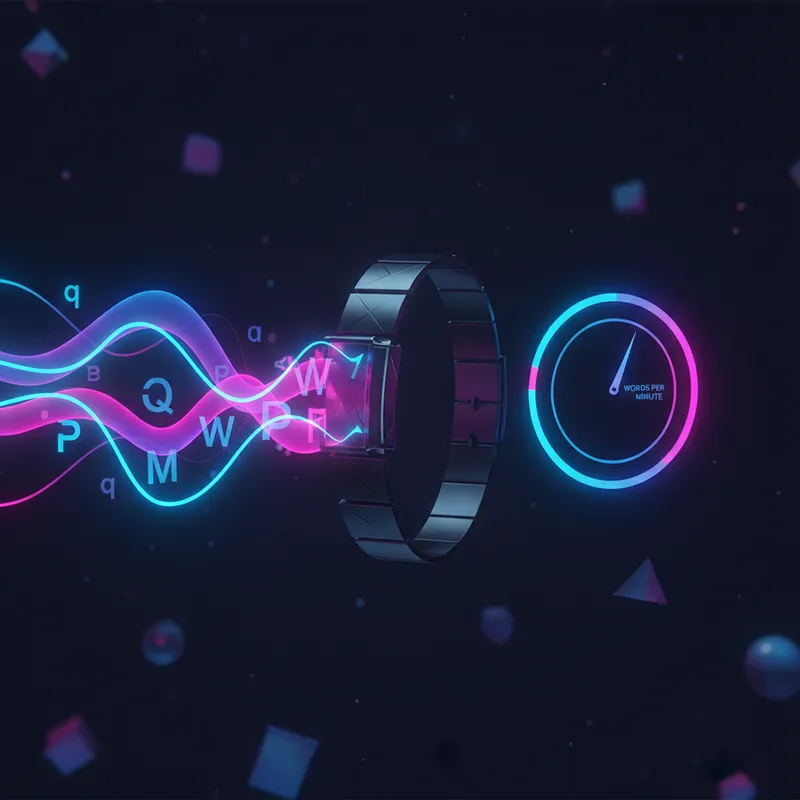
Typing tests have always assumed keys. But surface electromyography (sEMG) wristbands are changing that: they sense the tiny electrical activity in forearm muscles and translate it into commands—clicks, swipes, even handwriting and typing—without a physical keyboard in view. Meta’s Neural Band ships with its Ray‑Ban Display glasses in the U.S. and is designed for subtle, always‑available input with millisecond‑level responsiveness, positioning EMG as a mainstream accessory rather than a lab curiosity. That opens the door to a new test mode: a “phantom keyboard” that measures typing skill from muscle signals instead of keystrokes. (about.fb.com)
The research wave you can build on
Two recent lines of work make this practical for a typing test:
- Large public datasets. emg2qwerty logs wrist EMG while touch‑typing on QWERTY: 108 participants, 1,135 sessions, 5.26 million keystrokes, 32 channels at 2,000 Hz—ideal for training baselines and evaluating decoders. (nemar.org)
- Generalizable decoders. A 2025 study describes a 16‑channel, 2 kHz wristband and generic models that work “out of the box” across people, with personalization boosting performance. They demonstrate closed‑loop handwriting at roughly 20.9 WPM and robust discrete‑gesture control—evidence that EMG input can be scored like other text entry methods. (pubmed.ncbi.nlm.nih.gov)
Even earlier, “invisible keyboard” experiments (camera‑based, not EMG) showed people can approach standard typing speeds with practice—useful precedent for the concept of keyless text entry. (researchconnect.stonybrook.edu)
What your Phantom Keyboard mode should measure
You don’t need physical keys to compute familiar metrics:
- WPM: Use the standard formula based on decoded, correct characters: WPM = (correct characters ÷ 5) ÷ minutes. Also track “raw WPM” using all decoded characters (before corrections). (support.typing.com)
- Error rates: Adopt the text‑entry community’s corrected and uncorrected error metrics so users aren’t penalized twice for on‑the‑fly fixes. These derive from the Soukoreff–MacKenzie framework. (yorku.ca)
- KSPC‑like efficiency: Define “virtual KSPC” as (decoded tokens, including edits like Backspace gestures) ÷ (final transcribed characters). This mirrors classic KSPC and captures how much extra work the decoder demanded. (yorku.ca)
A calibration‑first flow (fast, fair, and repeatable)
Design your EMG test like a mini on‑ramp before the timed run:
1) Device handshake and signal check
- Confirm sample rate and channels from the band (many wrist systems operate around 16 channels at 2 kHz). Verify contact quality and noise floor; prompt the user to adjust fit if impedance looks poor. (pubmed.ncbi.nlm.nih.gov)
2) Short per‑user warm‑up (2–4 minutes)
- Collect a small alphabet and common bigrams (e.g., “th,” “er,” “the quick brown fox…”), plus a few editing gestures (Backspace, Space, Enter). Fine‑tune a generic model with these samples to align the decoder to the individual’s physiology and wristband placement. Generic‑plus‑personalized pipelines have been shown to improve text and gesture decoding. (pubmed.ncbi.nlm.nih.gov)
3) Drift sentry
- Between passages or every 30–60 seconds, insert a 3–5 second “anchor” (e.g., three thumb‑taps + Space) and check feature similarity vs. the user’s calibration template. If similarity slips (electrode shift, sweat, strap loosened), pause the clock and offer a “re‑seat band” wizard—log these pauses so scores remain fair across users. Cross‑session variability and electrode displacement are known challenges in sEMG. (pubmed.ncbi.nlm.nih.gov)
4) Accessibility guardrails
- Offer an optional “gesture‑first” mode (predictive text + discrete gestures) for users who can’t or prefer not to perform fine finger movements. Wrist EMG can be helpful when vision‑based hand tracking fails or for users with limited mobility—positioning this as an inclusive alternative input. (meta.com)
Scoring pipeline: from signals to words‑per‑minute
- Inference stream: Your decoder outputs characters and edit gestures with timestamps.
- Text assembly: Apply edit ops in sequence to form the transcribed text; keep the full “input stream” to compute virtual KSPC and corrected errors.
- Metrics:
- Net WPM from final text; Raw WPM from all decoded characters.
- Corrected and uncorrected error rates per Soukoreff–MacKenzie; report them side‑by‑side to avoid double‑penalizing. (yorku.ca)
- Virtual KSPC = (characters + edits) ÷ characters; Backspaces‑per‑character as a secondary signal of decoder burden. (yorku.ca)
Practical implementation tips
- Strap fit and contact quality: Teach a quick fit routine (snug, consistent placement). Poor contact adds noise and hurts generalization. Use a simple indicator based on EMG RMS and common‑mode levels. (pmc.ncbi.nlm.nih.gov)
- Sampling and filtering: Most wristband research samples sEMG at ~2,000 Hz; high‑pass around 20 Hz and envelope/RMS features are common starting points. Respect anti‑aliasing if you downsample. (pubmed.ncbi.nlm.nih.gov)
- Prompt design: Mix easy words with punctuation to exercise edit gestures; randomize passages to avoid overfitting to a phrase.
- Comfort mode: Provide a short “rest” key to pause without losing calibration—fatigue can change muscle recruitment and shift distributions. (pmc.ncbi.nlm.nih.gov)
- On‑device privacy: If supported, keep decoding local; Meta states its EMG translation runs on‑device, which users appreciate for privacy and latency. (meta.com)
Fairness by design
EMG varies across people (age, BMI, skin hydration, anatomy) and across sessions. To keep scores comparable:
- Personalized warm‑up: Always adapt a generic model to the individual before scoring.
- Drift logging: Record re‑fit events and pauses so leaderboards don’t privilege users who happened to get a perfect first placement.
- Demographic robustness: Periodically audit your decoder using public datasets collected for diverse populations to check for group‑wise performance gaps. (openreview.net)
Where to start: data and baselines
- Train or evaluate on emg2qwerty (characters + synchronized keystrokes) to prototype your decoder and metric pipeline. (nemar.org)
- Study the 2025 generic neuromotor interface for architecture clues (16‑channel wristband, 2 kHz sampling, personalization effects, and closed‑loop handwriting speed). (pubmed.ncbi.nlm.nih.gov)
- Keep classic text‑entry metrics handy—the WPM formula and unified error framework are mature and map cleanly onto EMG‑decoded text. (support.typing.com)
The takeaway
You don’t need keys to measure typing skill. With a short calibration, a drift sentry, and standard text‑entry metrics, an EMG “phantom keyboard” mode can feel fair, fun, and rigorous—meeting users where they are, whether they’re wearing display glasses, testing accessibility options, or just curious about the future of typing. And because wrist EMG is peripheral and non‑invasive, it’s a practical way to bring neural‑adjacent input to everyday typing tests. (about.fb.com)